Dear Senator Favola,
I drive an electric vehicle. And Senator, I know what I'm about to say has fallen on so many deaf ears and it's not exactly the focus you've made as my duly elected representative, but please hear me out.
An electric car is most assuredly not a hybrid car. 12 years ago, when the Toyota Prius first came to America, this car was seen as expensive, barely tested domestically and were only available in a limited number of major dealer showrooms. Now, the Prius is Consumer Report's pick for the best-valued car available, millions of miles have been driven in this car and other hybrids alike and you can pretty much walk into any dealer showroom and pick up a hybrid car of your very own. That was yesterday's revolution and for taking that risk the Commonwealth awarded the privilege of Single-Occupancy access to Virginia's HOV lanes. Apparently for life. What a wonderful reward!
But now hybrid cars are ubiquitous, and people have no concerns about buying one. There are millions of hybrids on the roads today. Do they really need an HOV subsidy on top of all this?
Over ten years of unequivocal, single-occupancy access to Virginia's HOV lanes is quite a benefit for a risk of that nature.
But an electric car is not a hybrid car. Today, electric cars are expensive, barely tested domestically and are only available in a limited number of major dealer showrooms. In short, electric cars are today where hybrid cars were 12 years ago. Indeed, with all the sacrifices of distances practically obtainable and slow-to-arrive infrastructure, electric vehicle drivers are even more handicapped than hybrid vehicle drivers ever were! And yet as far as the Commonwealth is concerned, an electric car is just another hybrid car. No, it's worse than that, the electric car is seen as the millionth hybrid car, meaning it can't access I95 or I395 HOV, it can't even access I66 HOV with single-occupancy. In effect, we're telling the people of places like Springfield and Arlington to please enjoy the reduced emissions of some hybrid vehicles but no, we don't want any zero-emission vehicles coming through your regions on your major highways. We want you to be polluted with yesterday's technology.
Why does the Commonwealth not give the same benefit enjoyed by thousands of hybrid risk-takers, who've already had their day and then some, to those of us even bigger risk takers driving an electric vehicle? Is that too much to ask? Does it even seem fair to deny electric vehicles those rights enjoyed by hybrid cars just because they came later, as newer, better, revolutionary technology always does?
I hope now you can understand why I'm so saddened by the current state of affairs. But I'm a pragmatist so I would like to ask you to make a motion in the Virginia Senate of the following nature:
Enact a law which would issue a series of low-emission, adhesive stickers which are affixed to the rear of a qualified vehicle at a cost to the driver of approximately $25 per year.
These stickers would only be authorized for cars which are plug-in electric or battery electric vehicles. This non-exclusive list includes:
- 2013 Chevrolet Volt 1.4L
- 2013 Ford C-Max 2.0L Energi (not the Hybrid)
- 2013 Ford Focus Electric[1]
- 2013 Nissan LEAF[1]
- 2013 Toyota Prius 1.8L plug-in
- 2013 Tesla Model S[1]
- 2012 Chevrolet Volt 1.4L
- 2012 Fisker Karma 2.0L
- 2012 Ford Focus Electric[1]
- 2012 Mitsubishi iMiev[1]
- 2012 Nissan Leaf[1]
- 2012 Tesla Roadster[1]
- 2012 Th!nk City[1]
- 2012 Toyota Prius 1.8L plug-in
- 2011 Chevrolet Volt 1.4L
- 2011 Nissan LEAF[1]
- 2011 Tesla Roadster[1]
- 2010 Tesla Roadster[1]
- 2009 Tesla Roadster[1]
- 2008 Tesla Roadster[1]
[1] (1, 2, 3, 4, 5, 6, 7, 8, 9, 10, 11, 12, 13) Battery electric, meaning no tail pipe emissions.
On 1 July 2013, amend Virginia Code § 46.2-749.3 to disallow the transfer of Clean Fuel plates to another, newer vehicle if the vehicle being transferred from is one in the following list:
- 2005 Ford Escape
- 2005 Honda Civic
- 2005 Honda Insight
- 2005 Toyota Prius
- 2004 Honda Civic
- 2004 Honda Insight
- 2004 Toyota Prius
- 2003 Honda Civic (and earlier)
- 2003 Honda Insight (and earlier)
- 2003 Toyota Prius (earlier)
These drivers will however have the option to purchase one of the cars in item 2 and obtain a low emissions sticker for that vehicle.
On 1 July 2013, amend Virginia Code § 46.2-749.3 to cease Clean Fuel plate registrations for the list of cars specified in item 3.
Thus anyone whose term for re-registration for any of these cars occurring after 1 July 2013 will be required to purchase a new plate without the Clean Fuel logo, and all HOV access will be rescinded for that particular vehicle.
On 1 July 2013, allow all cars with the appropriate Low Emission sticker access to all of Virginia's HOV lanes as single-occupancy. Let part of the revenue generated from the adhesive go to the Virginia State Police fund for identifying vehicles qualified for single occupancy in an HOV lane.
In subsequent years, phase out the rest of the clean fuel plates starting with the 2006 series, each year until Virginia Code § 46.2-749.3 is expired due to attrition and be replaces with the adhesive sticker system.
Negotiate with Annapolis to come to a cooperative agreement whereby any vehicle with Maryland plates and the equivalent electric vehicle sticker is allowed the same rights as a Virginian in Virginia with the low emission sticker and that likewise Low-Emission be respected in Maryland for single-occupancy HOV access.[2]
[2] As most of Virginia's HOV lanes are near the border with Maryland, this would be of keen benefit to most who would be effected by this law.
- Annual engineering analyses shall be performed each year to determine if any of Virginia's HOV lanes are operating at a capacity no worse than the normal traffic lanes. If the result be that the HOV lanes are near capacity, a second generation of stickers shall be issued which remove access to the most used HOV corridors.[3]
[3] Similar to what happened in 2006. I believe this progression to be fair as it doesn't take away access for older hybrids right away and provides everyone with a way to be cleaner and allows an out for anyone who already upgraded since at least they're driving a cleaner hybrid rather than the dirtiest of hybrids from 2005 and earlier. Engineering studies would need to be performed to make sure that the elimination of the older, clean fuel cars would make enough way for the Electric cars but if not perhaps in 1 July 2013 we could just give equivalent access to tier 3 clean fuel until such time that enough of the hybrid cars were retired to leave room for the electric vehicle.
In any case, thank you for reading and I sincerely hope you'll consider this in the upcoming General Assembly term.
Sincerely,
Jeffrey C. Jacobs
Thursday, January 3, 2013
Open Letter: Electric Cars are not another Hybrid


Monday, November 26, 2012
Open Letter to the Arlington County Board of Supervisors

Tuesday, 27 November 2012, at around 18:15, the Arlington County Board of Supervisors plans to hear final comments on EV Taxicabs' proposal to add 40 100% electric Nissan LEAFs to the to the fleet of vehicles certified to operate in the County before a final vote planned for later that evening.
#1 Courthouse Plaza 2100 Clarendon Boulevard Room 307 Arlington, VAThis is my open letter to the County:
Ladies and Gentlemen of the Board,
I address you today as an Electric Car driver with over a year experience with what an area EV driver can expect in terms of mileage and usage in our Northern Virginia climate. You see, I live in Herndon, Virginia, quite near to Dulles airport—I often hear the planes overhead at my house—and generally drive at least 70 miles a day between home and work with no chance to charge my car in between. In fact, I come to you today having driven from my home this morning to my job in Southeast D.C. and here thereafter with not a single opportunity to supplement my car's energy. But I'm not worried about getting home because I drive the same car, a Nissan LEAF, which EV Taxicabs is planning to roll out in its bid to the Board. If I could make it from my home near Dulles Airport to a point farther than Arlington County and back again on a daily basis, at mostly highway speeds, in rain or shine, under all weather conditions, and still have enough juice in my ride to go another 10 miles, I can guarantee EV Taxicabs can handle any average fare to the airport and still make it back with miles to spare. And for the record, I've never run out of fuel and I've never heard of any EV driver who has. We're well prepared for our daily needs and quite knowledgeable about how far we can go and where we can stop along the way if need be.
As for fast charging using the CHAdeMO standard, which stands for stop and have some tea, this use case has already been well studied by EV Taxicabs and as an independent driver who writes extensively on the benefits and limitations of electric vehicles and the Nissan LEAF I wholeheartedly and unabashedly concur with their proposal. EV Taxicabs has already attested through actual real-world analysis that a typical electric taxi will only need one CHAdeMO or Fast Charge per day. But that said, it's Nissan itself that has said multiple fast recharges of their LEAF in the same day would be okay as long as the battery temperature stayed below a certain threshold. This might be a concern for temperatures like they have in Arizona but in Arlington it doesn't get nearly that hot. And again it's EV Taxicabs', and Nissan, who take all the risk if this be not the case. Nissan is very interested in seeing the results of EV Taxicabs usage, including multiple fast recharges. That's the only real test of a battery's longevity. And Nissan is willing to stand behind this proposal. And as far as where these fast charge stations will be located, EV Taxicabs has already planned that out too. Put them where the drivers can stop and have some tea, metaphorically. But not only will the cab drivers, we ordinary citizens will have access to these stations. And I urge the Board to consider this indirect consequence: drivers like me who might never stop in the county now have an incentive to do so. Now, instead of heading straight back to Fairfax County from work, I have an excuse to stop of in Arlington, buy a tea, coffee, sandwich, book and what have you and then be on my way to some other place rather than home. You free me to travel farther and in return you generate more business in the County. And it would cost the County absolutely nothing. The risk is all EV Taxicabs and even if they fail the County gets to keep whatever CHAdeMO stations they leave behind so we can continue to have our tea in the County.
It's clear that somebody has to be first, but this isn't the case for EV Taxis. EV Taxis have had great success in London, UK, Amsterdam, the Netherlands, Toronto, Ontario Canada, Mexico City, Mexico and Sao Paulo, Brazil. Even New York City is adding EVs to their very tightly controlled Taxi fleet. And surely if cold New York and hot Sao Paulo can handle an electric taxi, Arlington can. It's too late to have the pride of being first, but what EV Taxicabs proposal builds on the successes and failures of those other electric taxi corporations. Their plan is tested and proven and good for the county. And let's not forget this isn't a permanent assignment. If they don't perform to EV Taxicabs expectations in terms of business, those allotments will revert back to the county in good time. It's all EV Taxicabs risk to fail, the county and the county citizens won't have to spend a dime if these cabs don't perform. That's a risk EV Taxicabs is willing to take, and one they and I feel very strongly about its success!
And let's not forget the potential tourism it could generate to say Arlington County, Virginia is the place to go to get an Electric cab. If Congresswoman Janice Hahn or Senator Lamar Alexander were here, I'm sure they would agree with me, be they given a choice, that they would rather ride in a Nissan LEAF taxi than any other car. Believe me, those of us who made the switch always feel a bit out of sorts when we're required to ride in a conventional vehicle. That's an advantage EV Taxicabs has. I even spoke with former Loudoun County Supervisor Stephens Miller and he agrees EV cabs would be good for the county. That's the kind of press that gets guest at our Arlington County hotels and restaurants, and not in Bethesda or Silver Spring or Alexandria.
As for where a Taxi driver can charge his EV overnight, a quick search of the Plugshare database shows no less than 26 public charging stations are currently on-line in Arlington County. While it's true that it's sometimes hard to get a dedicated spot for refueling ones EV, many of the Vornado properties do have dedicated charging stations available to their residents and what's more most of those 26 stations won't be occupied at night. For the most part, they're currently used by daily shoppers and commuters who go home in the evening. And please keep in mind the cars EV Taxicabs will be buying will have what's called 6.6kW charging capability, meaning they can go from empty to full in under 3½ hours, or half a night's sleep. Although 26 public level-2 charging stations won't be enough to satisfy all 40 cabs EV Taxicabs is requesting, part of their business plan, as I understand it, will be to ensure that each driver is properly trained and has a location to house his or her vehicle while off duty. This is thanks in large part to their diligent pursuit of contracts with Nissan Motor Corporation to obtain cars at volume pricing. With that come jobs for local contractors who Nissan and Aerovironment will hire with to install as many level-2 stations as required by EV Taxicabs' drivers. Nissan and Aerovironment have worked with customers from the beginning and will do everything they can to make sure drivers have a place to charge their vehicle at night. After all, this is a demonstration project for them as well, and it behooves them as much as EV Taxicabs to get it right.
Finally, I would address that the questionable County Transportation Committee recommendation, which I should point out comes without even a Quorum, proposes no less than to give business to those who already have it. Is it no wonder EnviroCab was recommended the plurality of cab allotments? Are we really going to reward the more business to those that already have it? Are we going to abdicate any possibility of further competition? I would be willing to wager EnviroCab's tests of an EV were flawed because their drivers weren't properly trained. This won't be the case with EV Taxicabs. They plan to have all their drivers undergo a coursework at Nissan HQ for the car they will be driving. I have no doubt these drivers will be as skilled as any of my EV driving colleagues. Keep in mind EV Taxis will cost less to run which will allow the passengers savings and that's the type of competition we need to keep prices down for all fares. I will grant that EnviroCab received a very respectable score of 83 in the 17 November 2012 Board Meeting notes, Appendix B. Indeed, only one company scored better: EV Taxicabs with a score of 84!
It's for these reasons that I urge the Arlington County Board of Supervisors to approve EV Taxicabs bid for an allotment of up to 40 cabs. Their proposal is good for the citizens of the county, good for County Business, good for visitors to the region and good for the County Government's bottom line.
Sincerely,
Jeffrey C. Jacobs
Electric Car Driver, Advocate and Writer
Tuesday, November 29, 2011
An Opened Letter to the President of the United States of America
Dear Mr. President,
Thank you sir for being such a great advocate for American energy independence and providing the American people with a choice over what type of vehicle they drive. As the administrator of the Affordable Electric Car NOW! website, I wholeheartedly agree with your goal to see one million electric vehicles on American roads by 2015, just as we saw with hybrid electric vehicles in 2005. But I also recognize the limitations of the Office of the President in driving this great nation toward that lofty yet attainable goal.
Let's be frank, Mr. President. You can't control Congress. You can't control the Supreme Court. You can't control the private sector. There are a lot of things the President has no control over, but there is one thing you can, Mr. President: the federal infrastructure!
President Obama, if you want to see one million EVs on the road by 2015, the most effective thing you could possibly do is require all federal facilities provide a place where employees and contractors can charge their electric vehicles. This isn't to say that this should be a free service which would none the less reduce our dependency on foreign oil; a nominal fee that reflects the going local electric rate would be more than reasonable. But the important thing is to let the federal workforce charge at their federal installations. This would eliminate the most salient of potential EV Buyer's fears. This, Mr. President, you can control.
Thank you.
Tuesday, October 25, 2011
The Commonwealth's Six-Year Transportation Plan Meets Today
My helpful Commonwealth Delegate Tom Rust, who is currently running unopposed, conveyed a bit of information which I certainly found interesting and I hope you will too.
N. Virginia Transportation Meeting Is Oct. 25
Board seeks input on highways, rail and transit projects
The Secretary of Transportation and the Commonwealth Transportation Board will conduct nine public meetings across the state in October and November. These meetings are being held to give stakeholders the opportunity to review and provide comments on projects and programs to be included in the Fiscal Year 2013-2018 Six-Year Improvement Program. This includes highway, rail, and public transportation initiatives. Following the open house from 6:00-6:30 pm, there will be and opportunity for the public and transportation stakeholders to comment. Written comments may also be submitted during this informal session, or they may be mailed or e-mailed until December 12, 2011. The Northern Virginia meeting will take place on Tuesday, October 25 beginning at 6:00 pm at the VDOT office, 4975 Alliance Drive in Fairfax.
I plan on attending this meeting to speak about an issue very important to me at the Commonwealth level: Electric Vehicle access to High-Occupancy Vehicle lanes with single occupancy.
Electric Vehicles Too New for HOV
The Clean Fuel Club

In Virginia, we've had 3 different phases of the HOV easement for clean fuel vehicles. It all started with House Bill 1881 and Senate Bill 771 of the 1993 session of the General Assembly, which established the Clean Fuel license plate and is the origin of the Virginia Code § 46.2-749.3. Special license plates for clean special fuel vehicles. (Unfortunately, the on-line legislative records don't go back as far as 1993 so I can't provide an exact link to the text of these bills.) Then in the 1994 session, Senate Bill 71 added an easement to allow Clean Fuel vehicles to use the HOV lanes as single occupancy as per Virginia Code § 33.1-46.2. Designation of high-occupancy vehicle lanes; use of such lanes; penalties. However, this bill only extended the easement up until 1 July 1997; the law was later amended by 1996 Senate Bill 274 and 1996 House Bill 585 to extend the easement to 1999 and by 1999 Senate Bill 1068 to 2004 and finally by 2003 House Bill 2316 to 1 July 2006.
It was a brisk, autumn morning while on my way to work my 1995 Nissan Altima was totaled by a minivan at the American Legion Bridge. It was 2000 and the hot, new technology was the 2001 Toyota Prius and the 2001 Honda Insight: the first generation of hybrid cars. I needed a new car, and I wanted one badly! But the Prius was back-ordered for months and I needed to get to work; I couldn't wait. So I resigned myself to the most fuel-efficient car I could get in the full-sized class. I'm still driving that 2001 Toyota Avalon today.
Around this time the Federal Government started to get involved in national guidelines for HOV designation and usage. On 10 August 2005, Public Law 109-59 was passed, adding Section 166: HOV Facilities to 23 United States Code, Chapter 1. This set at the Federal level the allowances already specified by the Commonwealth, which was charged with defining rules for its Clean Fuel easement by 30 September 2009. Yet while the U.S. Congress was providing an HOV easement for all, Virginia was beginning to clamp down.
Second-Class Clean

On 19 April 2006, the Virginia General Assembly passed House Bill 1248 and Senate Bill 454, which amended Virginia Code § 33.1-46.2 to define a second type of Clean Fuel plate. This new plate would begin issue on 1 July 2006 and entitle any vehicle which bore it an easement to travel on any HOV lane in the Commonwealth of Virginia except along the I95/I395 corridor. Where as any car registered before 1 July 2006 would continue to be given carte blanche access to all of Virginia's HOV lanes with single occupancy. With this new provision, the easement was extended another year where by both types of clean fuel plate would be allowed to use the HOV lanes outside of I95/I395 and the older plate allowed to continue using those lanes too.
I was quite angry when this was announced. After all, I had wanted to get a hybrid, but they weren't available. I certainly wasn't going to trash a five-year-old car for a new one at that point. As an environmentally conscious individual, such waste would have been anathema to my nature. So instead I planned. I knew that my car should last another 5 years, and I knew the days of better technology were coming. This was the seeds of the website you see here: if I couldn't have a car with clean enough fuel for all HOV, I'd get an even cleaner fueled vehicle for my next automobile! I'd get an electric car.
This system of two-tiered Clean Fuel categories was extended to 1 July 2008 by 2007 House Bill 2132, to 1 July 2009 by 2008 House Bill 1014, to 1 July 2010 by 2009 House Bill 2476 and finally to 1 July 2011 by 2010 House Bill 214 on 11 March 2010 and by Senate Bill 552 on 10 April. On 20 April 2010, I placed a $99 reservation on a Nissan LEAF. Finally I was going to get my Electric Car! We were told that the Southeastern United States would be allowed to order the car in December 2010, and assuming 6 months of production, we'd have our cars by June, 2011. I might not be able to drive HOV single occupancy on I95/I395, but at least there would be I66 and VA 267, the Dulles Toll Road and Greenway.
Insult to Injury

On 10 December 2010, my dreams of driving electric were dealt a serious blow. The night before the delivery of the first production Nissan LEAF, they informed all reservation holders in the Tier 2 market, which at that time consisted of the 7 states of Alabama, Florida, Georgia, Maryland, North Carolina, South Carolina and Virginia, as well as the District of Columbia, wouldn't be able to order their car until Late Summer 2011. Late Summer 2011 ordering meant late autumn delivery at best; well after the end of the HOV easement 1 July 2011.
Why would I worry about that when the General Assembly had been steadily renewing the easement each year? It comes down the second part of 2010 Senate Bill 552. Just like 2006 House Bill 1248 and 2006 Senate Bill 454, the 2010 bill defined a third class of Clean Fuel plates with a further restriction: no more access to I66 HOV as single occupancy after 1 July 2011. By delaying the car release in Virginia by 8 months, Nissan was injuring its customers not only by the delay itself but by the fact that no LEAF bought in Virginia would qualify to drive on the HOV lanes of either I95/I395 or I66 with single occupancy. The 2011 Chevrolet Volt, with it's late 2010 release, would qualify, as well as any Smart ED leased here in addition to the Commonwealth's 2 or so Tesla Roadsters. None of those cars were released before 2006 and thus none qualify for the original Clean Fuel badge, but at least the handful that got in before the deadline get to use I66 single occupancy — but not the LEAF, not the Ford Focus Electric, not the Tesla Model S. Clean cars can drive, but Cleaner cars are left sitting in traffic.
On 28 March 2011, Virginia House Bill 1432 extended the HOV easement until 1 July 2012. Yippie! I can use HOV single occupancy if and only if I pay a toll. And the badge in the middle: how can I spell anything with that? It's ugly!
California
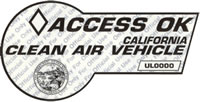
California knows how to treat environmentalists right. Effective 1 July 2011, while the Commonwealth of Virginia was taking away HOV rights from the first generation of Electric Vehicles, California started restricting its HOV single occupancy to only cars with a White sticker, meaning Super Ultra-Low Emission Vehicles (SULEV), Inherently Low Emission Vehicles (ILEV) and certain Ultra-Low Emission Vehicles (ULEV). The LEAF qualifies for this, but hybrid gasoline vehicles don't. Not even the Chevy Volt qualifies in California. Effectively, you need to be nearly Zero-Emission to get the White Sticker. The White Sticker easement extends until 1 July 2015.
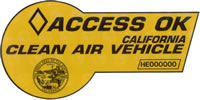
Yellow stickers for Hybrids and Advanced Technology Partial Zero-Emission Vehicles (AT PZEV). They were limited the first 85,000 applicants and expired as of 1 July 2011. California is also considering a new Green Sticker to begin distribution on 1 January 2012 and restricted to the first 40,000 applicants. It's unclear whether the LEAF would qualify for a green sticker, but according to the list of qualified vehicles, the 2010 Plug-In Prius does.
More information can be found in the California Clean Vehicle Incentives FAQ.
Maryland

In Maryland, Virginia's neighbor to the North, they also have an HOV easement, but they restrict it to plug-in vehicles only. This means the Chevy Volt and the Nissan LEAF qualify. I like the Volt so I like this system. I prefer Zero-Emission as the standard, like California, but the advantage of following Maryland's lead is that we could co-operate on the issuing of stickers and recognize them in both states. Thus Marylander could use Virginian HOV lanes and Virginians could use Marylander HOV. I also like the sticker approach because it ties the qualification to the vehicle and doesn't allow it to convey the benefit in perpetuity like you can with the original Clean Fuel plate in Virginia. I don't mind people who were early adopters having an advantage for HOV usage, but it's time for a new generation of early adapters. It's time for the Electric Vehicle.
My Speech
Now you know the background, here is what I'm planning to say tonight.
In 2000, when I bought my last car, it was next to impossible to get a hybrid. Hybrid vehicles were, after all, limited to a handful of custom imports and hobbyist vehicles. There were barely any of these new, clean cars on the roads of the Commonwealth back then. Hybrids were, after all, expensive, untested domestically and weren't even available in major dealer showrooms yet.
At that time Virginia Code § 33.1-46.2 Section A Paragraph 6, allowing single occupancy HOV usage to cars baring Clean Fuel plates, made a lot of sense. There weren't very many hybrids on the road so letting them use the HOV lanes wouldn't affect traffic congestion greatly.
However, as of mid 2011, we now have over two million hybrid vehicles on the road, and many of those are right here in Northern Virginia and around Washington, which boasted the fifth largest growth nationally in the hybrid market. The Commonwealth has adapted to this, limiting single occupancy access to certain HOV areas, but this favors the oldest hybrids and doesn't encourage our citizens to help our business by buying new cars.
Today, hybrid vehicles are ubiquitous. Plug-in and Battery Electric cars, however, are still rare. These newer, cleaner vehicles are today where hybrid vehicles were back in 2000 and 2001: expensive, untested domestically and not even available in major dealer showrooms yet. Just as the Commonwealth helped the nascent hybrid vehicle market to grow though the HOV easement, so too, I argue, that the next generation of even cleaner fueled vehicles should have that privileged.
It's time we cleaned up our clean fuel cars. It's time to put zero-emission vehicles on I66 and I95/I395. It's time for those busy and congested roads to produce no pollution for the housing that runs along these highways, where families live and children play. Don't we want to stop our voracious appetite for hydrocarbons coming from nations which dislike us? Isn't that the kind of kind of Virginia we should be striving for?
That part of the speech should run about 2½ – 3 minutes, which would be my allotted time; I'll therefore submit the rest of the speech as follows in written comments.
The way I see it, we have 6 options:
- Keep things as they are, with new, zero-emission vehicles restricted to VA 267 and no access to I95/I395, nor to I66.
- End the Clean Fuel HOV easement all together, which although fair would, I suspect, make no-one happy.
- Evolve the requirements for the HOV easement over time, expiring dirtier cars and creating openings for cleaner ones. We might not be able to tie this to specific CAFE standards according to the EPA, but at least we could work towards emission targets.
- Simply put a time limit on the HOV easement, so that the oldest cars only qualify for say 10 years and as those cars expire, new slots open up for the new generation of cleaner vehicles.
- Follow California by completely ending the easement for hybrid vehicles and only allowing Ultra-Low Emission, Inherently Low Emission or Super Ultra-Low Emission on our HOV lanes. I don't expect the Commonwealth to be this draconian but I see it as still preferable over the Status Quo. And finally…
- Allow only Plug-In Vehicles, vehicles that can be plugged into the wall, to take advantage of the HOV easement. As a resident of Northern Virginia I find this the best solution for the Commonwealth because it's the exact same rule which governs our neighbor Maryland. In fact, what would benefit the residents of Northern Virginia most would be if Richmond and Annapolis could set up a joint commission and co-operate on the issuing of this Plug-In easement such that each state would recognize the other's right to use HOV single occupancy within both states.
And finally, if we're to enact any but the first two options, I would recommend that we end the use of the Clean Fuel plate in favor of a non-transferable sticker, like California and Maryland. The ties the easement to the qualifying car and allows the Commonwealth to restrict usage to specific vehicles rather than to an owner, since it's the car we need to be clean.
I know I'm not making any friends with this viewpoint but in the long run, I see any of options three through six as in the best interest of the Commonwealth. Let's keep Virginia green and I thank you for your time!
I know this speech will rub a lot of people the wrong way, but it's from the heart and I feel it must be said. Will you join me tonight?
Friday, February 18, 2011
Help make Maryland EV Friendlier
Support for 3 bills currently before the Maryland Senate
In the current session of the Maryland Senate there are three important bills which will effect EV drivers in the state. At this month's EVA/DC public meeting, group vice-present, the extremely affable Charlie Garlow brought to my attention these bills and as we both support these issue, with his permission I am reproducing them here. As I don't actually live in Maryland I don't have a state Delegate or Senator in the Maryland General Assembly, I don't have anyone in the legislative branch to whom I can write, but I'd be happy to address letters of this nature to the Governor's office as a concerned citizen of a neighboring state, but as he proposed these bills, I'd just be preaching to the choir. I would encourage anyone in the state of Maryland to look up your Delegate and Senator and send them a letter like the ones below to encourage them to pass laws that will keep Maryland green!
Electric Companies - Pilot Program for Charging Electric Vehicles (SB 179)
Requiring the Public Service Commission to establish a pilot program for charging electric vehicles by June 30, 2013; authorizing an electric company to request to participate in the pilot program; requiring the pilot program to include incentives for residential, commercial, and governmental customers to recharge electric vehicles in ways that will accomplish specified goals; and requiring the Commission to report to the Governor and the General Assembly on the program by February 1, 2015.
Dominion Virginia Power is proactively developing new Electric Vehicle Residential rates, part 1 of which is available in a previous post, and it only seems fair that the state of Maryland should consider the same. Currently, 6 power utilities (PU) operate in Maryland:
- PEPCO
- BG&E
- Delmarva Power
- Allegheny Power
- Southern Maryland Electric Cooperative
- Choptank Electric Cooperative
Of these, PEPCO and BG&E are the biggest. This bill would act similarly to the Dominion Virginia Power EV pilot program in that it would establish special billing rates for a limited number of homes with electric vehicles. It would then monitory electricity usage by these homes in order to establish a long-term resource requirements as the number of homes with electric vehicles increases within the state.
As of 17 February, the bill has passed the Maryland Senate on its third reading but has yet to be taken up by the Maryland House of Delegates. The text of the bill can be found here.
Maryland Electric Vehicle Infrastructure Council (SB 176)
Establishing the Maryland Electric Vehicle Infrastructure Council; specifying the membership and staffing of the Council; requiring the Governor to designate the chair or cochairs of the Council; prohibiting members of the Council from receiving specified compensation, but authorizing the reimbursement of specified expenses; requiring the Council to submit an interim and a final report by specified dates; defining terms; etc.
This bill would establish a commission to investigate the needs of the state of Maryland in support of an increasing Electric Vehicle population in the state. The main focus will be to establish public Electric Vehicle Service Equipment (EVSE) stations at locations convenient for on-the-go charging. The establishment of such a panel will go far to mollify the fallacy of range anxiety. What's more, there's a good chance my friend Charlie could be appointed to this committee, and as vice-president of the EVSE he's well-versed about the needs of electric vehicle owners on Maryland.
As of this post, this bill is stuck in the Maryland Senate Finance Committee since 26 January. Sending letters to both your state Senators and state Delegates will go a long way to moving this bill through the general assembly. The text of the bill can be found here.
Income Tax - Tax Credit for Electric Vehicle Recharging Equipment (SB 177)
Allowing a State income tax credit for tax years 2011, 2012, and 2013 only, for 20% of the cost of qualified electric vehicle recharging equipment placed in service by a taxpayer during a taxable year; providing for administration of the tax credit by the Maryland Energy Administration; limiting the credit to taxpayers receiving initial tax credits from the Administration; limiting the tax credit to $400 for each individual recharging system; etc.
This bill has piqued the most interest for me personally. When the EVSE Tax Credit was extended in 2010, it was restored to its pre-2009 levels of 30%, $1,000 max. This meant that, effectively, the credit has been reduced your credit by 20% of your original installation value between 2010 and 2011. SB 177 plugs that gap by restoring that 20%, up to $400, when you file your Maryland state taxes. Although I've already taken my credit (though have yet to file), many people in Maryland are waiting for when they can buy an electric car, and 2011 is looking good here, so it's very likely if you're buying an EV in 2011, you'll want to install an EVSE in 2011. Thus, this credit should be quite popular this year.
What's more, as I stated in a previous post, many people won't be able to declare the EVSE tax credit in 2011 if they buy an EV the same year. What's more, if one installs photovoltaics or other Residential energy credits, one could also easily face the AMT pitfall. Thus, for many people, this credit for one's Maryland taxes may be the only tax credit one sees for the purchase of an EVSE in 2011.
As of this post, the bill is stuck in the Maryland Senate Budget and Taxation Committee since 26 January. Sending letters to both your state Senators and state Delegates will go a long way to moving this bill through the general assembly. The text of the bill can be found here.
Opened Letter
This open letter was written by Charlie Garlow and is provided as a sample for you to use, which I have modified slightly, to compose your own letter to your state Delegate, state Senator and Governor Martin O'Malley. You can find your Delegate and Senator here or simply call 1-800-492-7122. So show your support for making Maryland an EV friendlier state and write today!
To:
Members of the Maryland House of Delegates, Members of the Maryland Senate Annapolis, MD 21401
Dear Governor, Senators and Delegates,
I am an electric vehicle owner and advocate and urge for your support for SB 179, which would establish a pilot program for residential electric vehicle charging, SB 176, which would set up a commission to improve Maryland's electric vehicle infrastructure and SB 177, which would enact an electric vehicle service equipment (EVSE) tax credit to supplement the credit reduced by the federal government in 2011 and would still be available when faced with the Alternative Minimum Tax elimination of the credit at the federal level. I ask for you to vote for these bills, sponsored by the Governor because it will promote clean, electric transportation in Maryland and will make Maryland a leader in new technologies, drawing more clean inductry and jobs to our state.
Sincerely,
Your name, address and e-mail
Thursday, May 6, 2010
An open letter to members of the Government of the Commonwealth of Virginia
To:
The office of the Governor of Virginia,
Members of the Virginia House of Delegates,
Members of the Virginia Senate
As a fellow Virginian, I am hoping you can address this issue for me in the House of Delegates and / or Virginia Senate. In the early 2000s, the governor signed into law legislation that granted a High-Occupancy Vehicle (HOV) easement to early adopters of clean fuel technologies, as specified by the DMV, summarized here: http://virginiadot.org/travel/hov-rulesfaq.asp
This exemption to HOV restrictions was then ended for all cars registered after July 1, 2006 though all cars having been registered as Clean Fuel before this date have been grandfathered into continuing the easement beyond the the July 2006 deadline, with that allowance currently extended to June 30, 2011 (5 years – http://virginiadot.org/newsroom/northern_virginia/2010/hov_exemption_for_hybrid45786.asp).
Now, to be clear, the Commonwealth of Virgina is home to the Shenandoah National Park; the beautiful Commonwealth is exemplified by its pristine coasts, its horse and wine country and its Appalachian peaks. It is that which I love most about our home here in the Commonwealth and that which I feel strongly we should preserve. That is to say, I am greatly in favor of the HOV easement to encourage the citizens of our Commonwealth to do what they can to keep Virginia green. I, of course, don't want to confuse the Carbon Dioxide absorbed by plants with that which goes to creating a creeping greenhouse effect that would so change the Virginia of our great grandchildren from what we know today. But I do believe that the way to do this in Virginia is through incentives and encouragements and not through automotive mandates beyond the Federal CAFE standards. And as it is, Virginia's foliage could not come near to absorbing all the Carbon Dioxide the Commonwealth produce from its diverse sources. Most, in fact, is absorbed by the seas, but this is beyond my intended discussion.
The reason I am writing you, my fellow Virginians, is that we stand now on the cusp of a new clean fuel movement: that powered by the fully electric car, such as the Nissan Leaf. Unlike Hybrid cars, the Nissan Leaf, Tesla Roadster, Mini-E and other, currently rare, all-electric alternatives have NO tailpipe emissions and even if the electricity is generated by burning coal, it is still less of a Carbon footprint to drive an all-electric car than one that is even partly gas-powered, such as the Hybrid automobile.
It is such an advance in clean fuel, as in no direct carbon emissions of any kind, that makes this new generation of Electric Vehicles worth re-examining in terms of incentives. And now is the time to do so, as the market is still small and would not cost the Commonwealth very much.
Firstly, I believe now is the time to see a new HOV easement passed that exempts all-electric cars from HOV restrictions on I95/I395, as well as I66 and the Dulles Access Road / Greenway. The advantage of the HOV easement is that it does not cost the Commonwealth anything and would not add very many cars to the HOV lanes because there are still very few fully electric vehicles available at this time. Please recall that when Hybrid Cars were first allowed to use the I95 / I395 corridor, a study was performed to make sure that the number of Hybrid Cars that were expected to use the HOV lanes were not to exceed in terms of congestion the average traffic density of the non-HOV I95 lanes. This study was performed in the mid-decade. Since then, congestion on the I95 corridor has increased as newer developments have sprung up along the popular automotive route. It would therefore be quite appropriate for these traffic statistics to be re-evaluated for their current density and that the Fully Electric cars registered by a reasonable cutoff could be used to rebalanced the densities established in 2006.
Of course, I would like to add that any and all incentives toward ending tailpipe emissions in the Commonwealth is a laudable goal. Again, it is not the House of Delegates or Virginia Senate's role to mandate what must be done. Rather your jobs are to encourage, and to that end I would be so honored if you would also consider legislation that will ease the burden of purchasing all-electric vehicles as well as home charging stations. The Federal Government already provides a $7500 tax credit, as well as up to $2000 for up to 50% of the cost of installation of a home charging station. Any additional credits you could work to pass in the House and Senate would make me very proud to have you as my representative.
Of course, any incentive the House of Delegate or Virginia Senate can provide in terms of other energy savings would be appreciated. For instance, Chapter 17 of the current legislative session allows the cities, counties and towns to provide incentives for Photovoltaic and Vegetable Roofs. It is a wonderful start, but we can do so much more, such as tax credits for the residential construction of home Solar-thermal or Geothermal water heating / cooling facilities or home Wind power electrical generation. The second weekend in October consumption tax holiday for energy-efficient appliance upgrade is one possible model for this, but that only covers purchase up to $5000 and most of these energy generation solutions cost much more than that. Also, incentives for lower-incoming housing to use to upgrade their energy-inefficient domiciles to be more energy efficient would be of great help. Even subsidizing home energy audits would go a log way to both saving home owners money on energy bills allowing Virginian to do their part in keeping Virginia Green and fight global climate change.
It is my hope that we can build a coalition of Delegates and Senators who want to keep Virginia green so that we can be an East Coast leader in preserving the beauty of our land. Delegates like those who, in just the current 2010 session, helped pass HB 803 and SB 623 to create Green Jobs in the Commonwealth, or HB 1975 / SB 1058 to allow for green roof home modification incentives for localities, or SB 109 to require new government building to be green, or HB 389 / SB 577 to provide permits for off-shore wind farms. We should be proud as Virginians that you, our representatives, are doing these things for us. But we need to remain vigilant; there is so much more we could do.
Obviously, that's a lot to ask of you, my Representatives in Richmond, but I sincerely hope you will look into these and other environmental concerns and that you and your fellow Delegates and Senators and our esteemed Governor can work together to keep our Commonwealth beautiful!
Thank you!
Sincerely,
A Concerned Virginian